Little Earth
Good Morning, MidnightLittle Earth is the ring-shaped centrifuge aboard Aether, rotating independently of the rest of the spacecraft to simulate gravity through centrifugal force. It is at once a practical living space and the crew’s closest approximation of an earthly home: a place to sleep, eat, exercise, play, and gather while the emptiness beyond the ship presses in. As the mission’s routines falter, the ring’s ordinary furnishings become a measure of how much the crew still depends on one another.
Structure and layout
The ring contains six sleeping compartments, arranged as three roomy boxes on either side of a central aisle. Thick curtains provide privacy; shelves and drawers hold clothes, and small reading lights serve the bunks after the simulated sun has set. The design makes room for individual retreat without removing the crew from a shared interior: curtains can be drawn, but the compartments remain part of the same circuit.
Further along, a long table and two benches can be pulled into the aisle or pushed against the wall. Beyond them are a rudimentary kitchen and, completing the circuit, a small fitness center with a stationary cycle, treadmill, and weights. A gaming-console area has a futuristic gray couch, and a small lavatory sits between the couch and the bunks. The spacecraft also has a toilet in its zero-gravity section, but that one is considerably less popular. The details make Little Earth feel deliberately domestic, while its compact circular plan keeps domestic life inside the machinery of a spacecraft.
Gravity and the imitation of home
The ring’s gravity has practical comforts. Cards stay on the table, food stays on a plate, and a pencil can remain tucked behind an ear. For Sully, playing cards during allotted recreation time can briefly make the surrounding light-years of unexplored space recede; the table and the ordinary behavior it permits suggest an Earth of dirt, trees, and blue sky. The resemblance is only an approximation, however. After spending the day floating in the communications pod, she finds the full weight of her body tiresome, even as she recognizes the importance of staying acclimated to gravity.
Movement between the rest of Aether and Little Earth makes the change in bodily conditions tangible. Sully travels through the spacecraft’s padded gray passages and greenhouse corridor, where aeroponic grow boxes line the walls, then turns through a connecting entry node and drops onto the centrifuge’s landing pad. Gravity catches her feet; she pauses to regain her balance. Once she trusts her legs, she walks to the couch, concealing her fatigue by watching Tal finish a game. The two-year journey has weakened her muscles and worn down her health. The ring offers a place to practice weight-bearing life, but its gravity can also make her feel as though she has been running for hours.
Recreation and the fraying crew
Card games record a change in the crew’s social life. Poker had been the group’s game until Aether’s first pass through the asteroid belt, six months into the journey. The others gradually stopped joining in, and the games ended altogether during the distraction of the Jovian moon survey. When unease about the communications blackout brought cards back, only Sully and Harper wanted to play. Their new favorite was Rummy 500. Their joking accusations of cheating make the game an intimate, low-stakes contest, but its two-person table also marks how much smaller the crew’s shared recreation has become.
Other features of the ring register the crew’s isolation in less playful ways. After the survey and the loss of regular contact with Mission Control, schedules for sleeping, eating, and relaxing fell away. The crew began functioning as separate people rather than as a united team. Ivanov withdrew to the lab and became temperamental; Tal, physically present by the gaming console in Little Earth, retreated into games. The consoles offered him challenges that could absorb his attention, but his frustration also spilled into the common space. He hurled controllers and other equipment across the centrifuge, then spent the rest of a day trying to repair a shattered steering wheel, gluing plastic and testing its buttons. The room’s shared furnishings could not prevent his distress from becoming communal noise.
The ring also holds quieter forms of company. Sully finds Harper and Thebes reading there: Harper on a tablet, Thebes with a paperback he had insisted on bringing despite objections about the cargo space. The books had been approved as psychologically necessary equipment. In retrospect, Sully wonders whether stories made from paper originating on their home planet might be among the things helping Thebes remain grounded. The scene places a small, portable remnant of Earth beside the ship’s screens and exercise equipment, and makes the crew’s need for mental sustenance part of the room’s function.
A shared place for grief
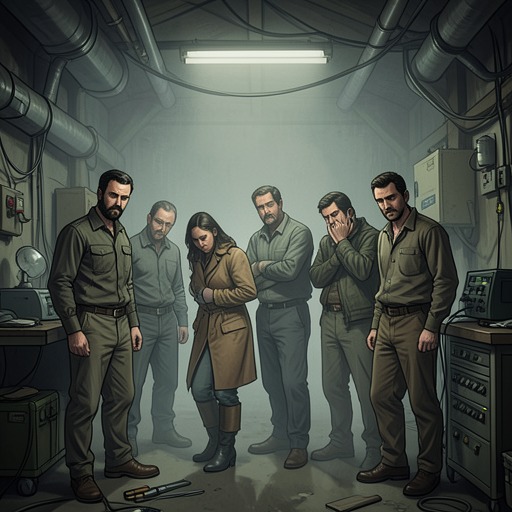
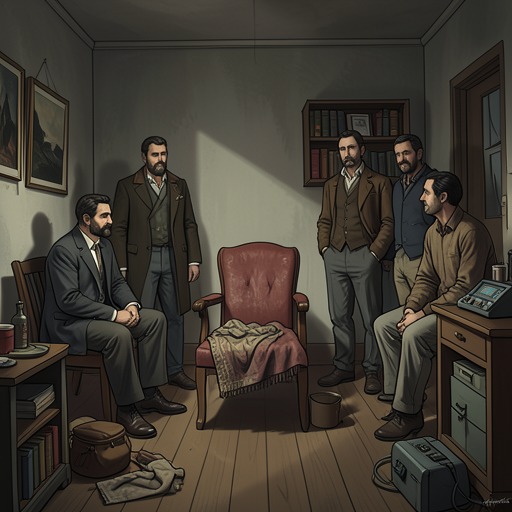
After Devi dies during the second spacewalk, the crew’s isolation acquires a common object of grief. Sully has been absorbed in getting the replacement communications system online, afraid that any gesture of sympathy will return her to the image of Devi disappearing beneath the bulk of her suit. But when she follows Thebes into Little Earth, she sees that he too has been diminished by the loss. The others have witnessed the same moment through the helmet cameras; it is not Sully’s tragedy alone.
The crew waits around the table. Ivanov is crying, and Sully realizes that she is crying too. They pass around their last tinfoil dish of shepherd’s pie, a premade meal they had saved for a special occasion, and eat without speaking. When the dish is empty, Ivanov takes Tal’s and Harper’s hands; the others follow, bowing their heads together. His words, “Aether has lost her youngest daughter. Protect her,” give their mourning the form of a collective appeal. Little Earth’s table, once the setting for cards and meals, becomes the place where the crew acknowledges that the loss belongs to all of them.
Little Earth’s significance lies in this contrast between its designed promise and the conditions lived inside it. Its gravity can steady a body, its table can hold a game or a meal, and its bunks can provide privacy; none of these can restore contact with Earth or guarantee a cohesive crew. Yet the ring continues to give the astronauts a shared setting in which routine, withdrawal, consolation, and grief become visible. Its domestic scale does not make the surrounding universe smaller. It shows how much the crew needs, and how little space they have, to make a home within it.